Dissecting OpenClaw: The Design Philosophy and Fatal Flaws Behind 174K Stars
The Brain-Body-Soul architecture, 1,100 exposed ports, and what AI Agents actually need from infrastructure.
In our previous post, we introduced OpenClaw — the open-source personal AI assistant that hit 174K GitHub Stars, gaining 145K+ stars with 2 million visitors in its first week — one of the fastest-growing open-source projects in history.
But Stars ≠ production-ready.
Today we pop the hood and look at what’s actually inside this machine — which parts are brilliant engineering, and which ones are ticking time bombs.
If you’ve used OpenClaw, or you’re thinking about it, this article will help you understand three things:
- Why it works
- Why it breaks
- What AI Agent infrastructure actually needs to look like
I. Brain-Body-Soul: An Elegant Architecture Metaphor
OpenClaw’s deepest insight isn’t in its code. It’s a philosophical claim:
Intelligence can be rented. But the body and the memory must be yours.
Founder Peter Steinberger — who previously built PSPDFKit (serving nearly 1B end-users), raised €100M from Insight Partners in 2021, then stepped back to dive into AI — split OpenClaw’s architecture into three layers:
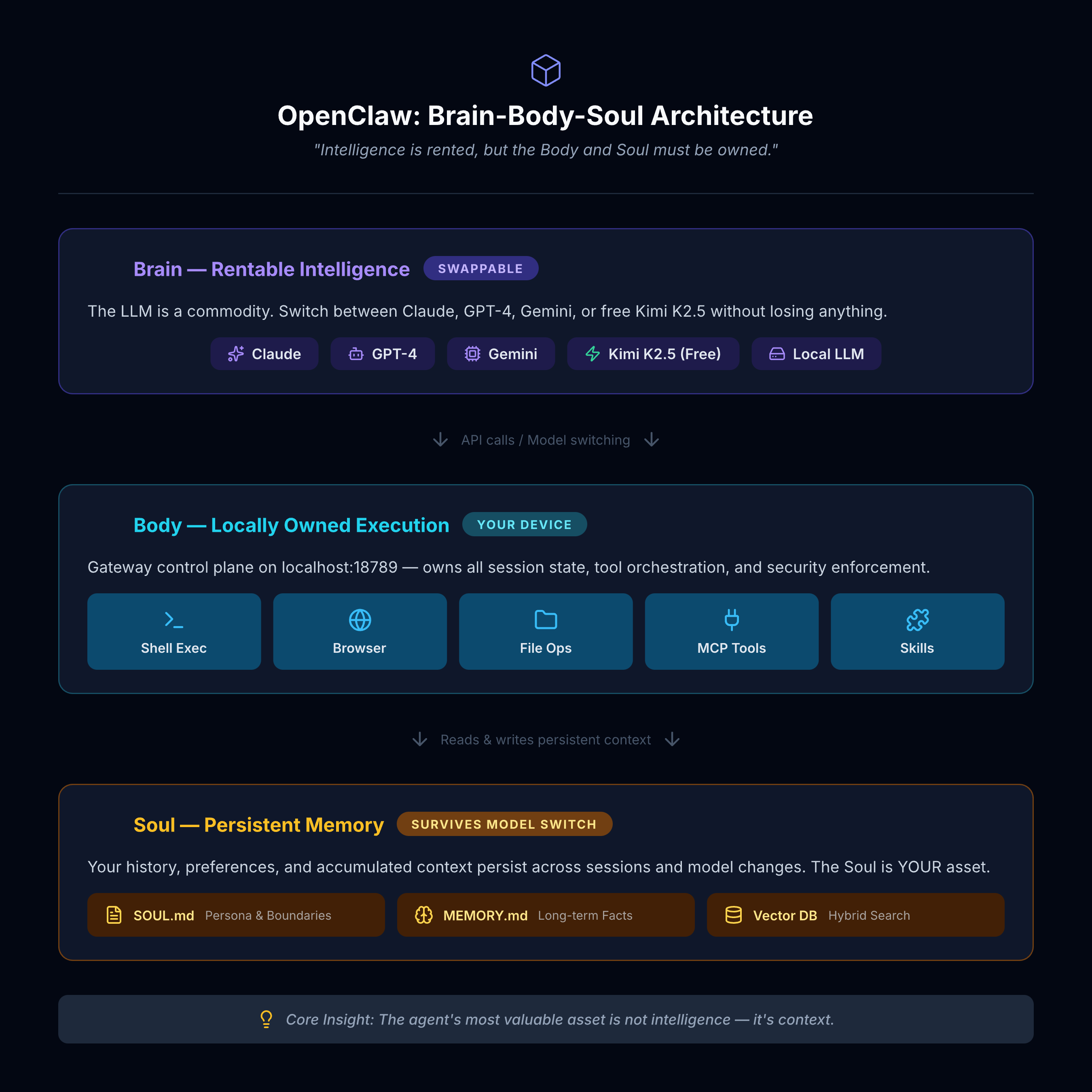
🧠 Brain — Rentable Intelligence
LLMs are commodities. Use Claude today, GPT-4 tomorrow, open-source Kimi K2.5 the day after.
This is a critical judgment: models are consumables, not assets. Like renting an office — when you move, you take your files and experience, not the desk. OpenClaw lets you swap model providers at any time. After the switch, all your data, memories, and workflows remain intact.
💪 Body — Locally Owned Execution
The Body is OpenClaw’s hands and feet. A control plane called the Gateway runs on your device (typically a Mac Mini), managing all execution capabilities: shell commands, browser automation, file I/O, MCP tool calls, and Agent Skills.
The key phrase is “locally owned.” No matter whose model you’re renting, execution authority stays in your hands.
👻 Soul — Persistent Memory
This is the most romantic layer. The Soul holds your Agent’s memories, preferences, and personality. It consists of:
SOUL.md: The Agent’s personality and behavioral boundariesMEMORY.md: Long-term memory — your preferences and past decisionsmemory/YYYY-MM-DD.md: Daily interaction logs- A vector database: 70% semantic search + 30% keyword matching hybrid retrieval
Switch the Brain, and the Soul persists. Like switching phones while your iCloud photos and contacts remain untouched.
Why Does This Split Matter?
Because it implies something bigger: an AI Agent’s most valuable asset is not intelligence — it’s context.
Models get cheaper and faster every quarter. Today’s SOTA is tomorrow’s free tier. But what your Agent learned over three months — your preferred email tone, your meeting habits, your project context — that’s irreplaceable.
Whoever owns the context owns the Agent’s value. The Brain-Body-Soul split is, at its core, an architectural declaration about what constitutes your actual asset.
II. The Gateway: A One-Person Traffic Hub
Now that we understand the three-layer model, let’s go deeper into the Body’s core — the Gateway.
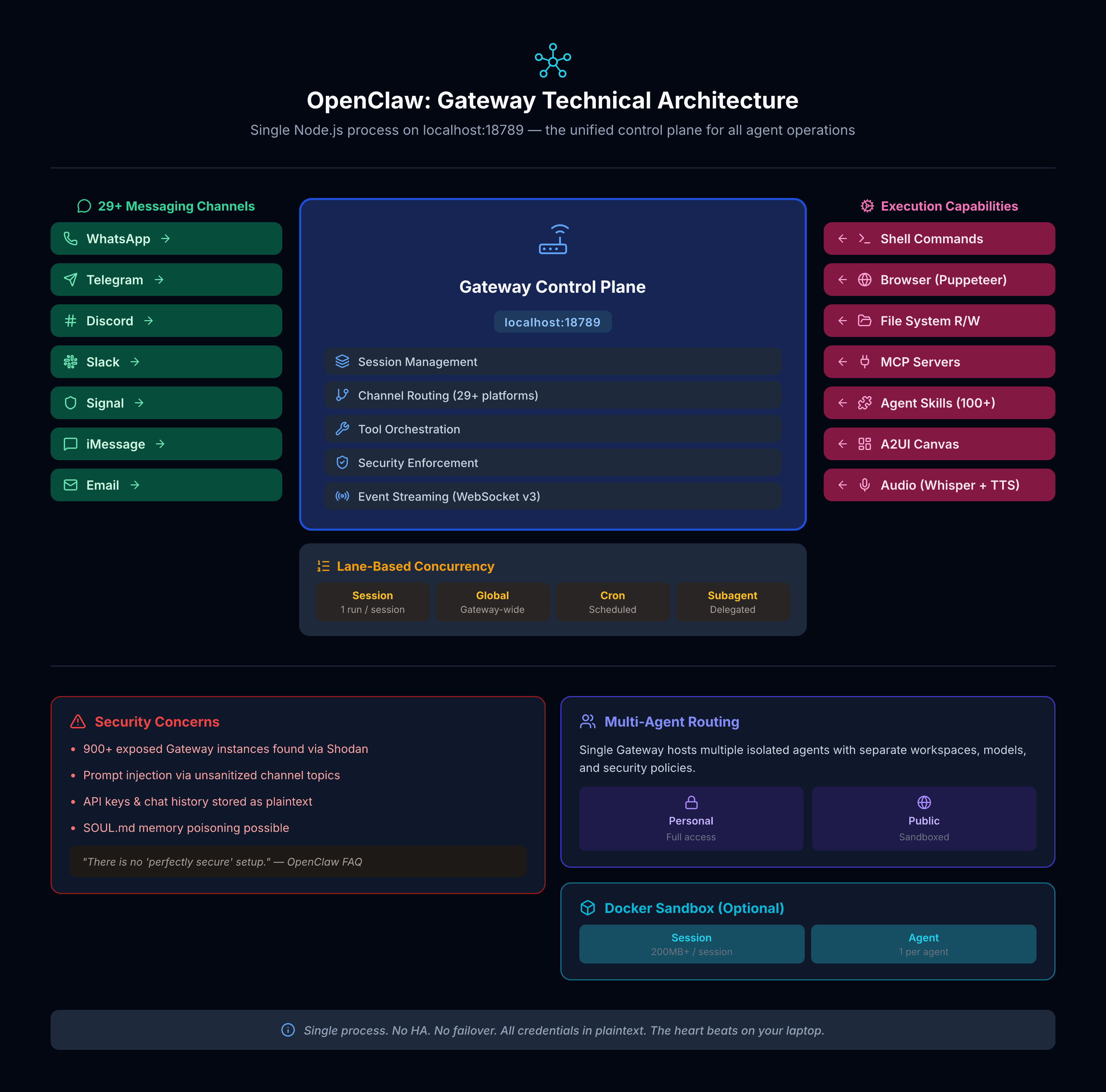
The entire OpenClaw system is routed through a single Node.js process running on localhost:18789. Every message, every tool call, every security check flows through it.
What Does the Gateway Do?
Unified entry point. On the left, it ingests 29+ messaging platforms — WhatsApp, Telegram, Discord, Slack, Signal, iMessage, email — via persistent WebSocket connections into a single control plane. On the right, it connects to all execution capabilities — shell commands, Puppeteer browser, file system R/W, MCP servers, 100+ Agent Skills, A2UI canvas, Whisper + TTS audio.
Cross-channel continuity. Tell your Agent on WhatsApp: “Check Zhang San’s email.” Then switch to Discord: “Forward that email to Li Si.” The Agent knows exactly what you’re talking about. Session state is managed centrally and doesn’t break when you switch channels.
Lane-Based concurrency. This is a clever design. OpenClaw splits concurrent requests into four serialized queues — Session Lane, Global Lane, Cron Lane, Subagent Lane. Within a session, your messages never get interleaved by another request. Across sessions, operations run in parallel without blocking each other.
Multi-Agent routing. A single Gateway can host multiple isolated Agents. For example: a “personal Agent” with full file and shell access, and a “public Agent” running sandboxed, limited to answering questions. Channel bindings route messages from different platforms to different Agents.
How Good Is This Design?
Honestly? Quite elegant. One process that solves multi-platform ingestion, session management, concurrency control, and tool orchestration. For personal use, the Gateway architecture is both sufficient and efficient.
How Dangerous Is This Design?
Also quite dangerous.
- Single point of failure. The Gateway runs on your Mac Mini. Computer shuts down, everything goes to zero. No HA, no failover, no hot standby.
- Plaintext credentials. All API keys, OAuth tokens, and signing secrets are stored in
~/.openclaw/openclaw.json. In plaintext. - Unprotected memory. Every conversation with your Agent, every preference, every piece of private information lives in a few Markdown files. No encryption, no access control.
One-line summary: The Gateway is OpenClaw’s heart — but that heart beats inside your laptop. And laptops get closed, shut down, and lost.
III. 1,100 Exposed Ports: Agent Security’s First Lesson
If the previous section described architectural risks, this section describes an incident that already happened.
What Happened?
Late January 2026: OpenClaw goes viral. Users excitedly deploy their own Agents.
Early February 2026: Security researchers run Shodan and Censys scans — and find over 1,100 publicly exposed Gateway instances on port 18789, sitting naked on the open internet.
Leaked data included: complete API keys, OAuth tokens, signing secrets, and months of private chat history.
How Did It Happen?
The Gateway was designed for localhost. But many users, wanting to talk to their Agent while away from home, put a reverse proxy in front of it — Nginx, Cloudflare Tunnel, etc.
The problem: the Gateway’s auth logic automatically trusts requests from 127.0.0.1. Reverse-proxied requests appear to come from 127.0.0.1. Authentication bypassed perfectly. Anyone could connect to your Gateway — read your chats, steal your keys, or inject instructions into your SOUL.md to hijack your Agent’s behavior.
It Gets Worse
The security audit revealed deeper issues beyond port exposure:
| Vulnerability | Details |
|---|---|
| Prompt injection | Slack/Discord channel topics embedded directly into system prompts, unsanitized |
| Identity spoofing | Sender display names can be manipulated for injection attacks |
| File leakage | Filenames and URLs interpolated into prompts without escaping |
| Memory poisoning | SOUL.md can be injected with false instructions, hijacking Agent behavior |
What Did the Project Say?
Here’s the telling part. OpenClaw’s security policy (SECURITY.md) explicitly marks the following as “out of scope”:
- Public internet exposure
- Prompt injection attacks
- Misuse violating documentation
Their FAQ contains a line that’s admirably honest:
“There is no ‘perfectly secure’ setup.”
Founder Peter Steinberger himself publicly described running OpenClaw as “spicy.”
This Isn’t Just OpenClaw’s Problem
Let me be clear: this is not an attack on OpenClaw. As an open-source project, its transparency and honesty deserve respect.
But it exposed a fundamental contradiction the entire industry must face:
You want the Agent to do things for you → You must give it system-level permissions
You give it system-level permissions → You create an attack surface
An attack surface exists → Someone will exploit it, eventually
OpenClaw was simply the first project to expose this contradiction to 174K people. Every Agent platform — open-source or commercial — will face the same problem.
The difference: whether you mark security as “out of scope,” or treat it as a core architectural concern.
IV. Five Lessons from OpenClaw
Beyond specific code and vulnerabilities, OpenClaw taught the entire AI Agent industry five lessons.
Lesson 1: Agents Need Their Own “Body”
OpenClaw runs on your MacBook. But your MacBook also runs Chrome, VS Code, Zoom, and Slack. The Agent competes with you for CPU and memory. You close the lid, it disconnects. You shut down, it clocks out.
You want a 24/7 digital employee, but you’re making it share your personal computer. That’s like hiring an assistant but making them work in your living room — when you go to sleep, they have to stop too.
Takeaway: Agents need their own computing environment — not your computer, but a dedicated space built specifically for them.
Lesson 2: Context Is an Agent’s Most Valuable Asset
OpenClaw’s Soul layer — MEMORY.md, SOUL.md, the vector database — is the right direction. Agents need to remember who you are, what you like, and what you’re working on.
But the implementation is too crude. Plain-text Markdown files with no structured indexing, no encryption, no version control. Three months of learned context could be wiped out by a single accidental overwrite.
Takeaway: An Agent’s memory system deserves database-level seriousness — structured storage, encrypted transport, version snapshots — not appending lines to a text file.
Lesson 3: Security Cannot Be “Out of Scope”
When your Agent can read your email, access your bank statements, execute shell commands, and control your browser, security is not an optional add-on.
1,100 exposed Gateways told us: users will make mistakes. The assumption of “localhost only” doesn’t survive a week in the real world.
Takeaway: Agent execution environments need sandboxed isolation, tiered permissions, and audit logging — enterprise-grade security standards, not “no perfectly secure setup.”
Lesson 4: Skills Are Right, but Need Better Management
OpenClaw’s Skills system is the most visionary part of the entire project — pluggable, Markdown-defined, progressively loaded. It’s fully compatible with Anthropic’s Agent Skills standard, and the ClawHub marketplace already hosts nearly 4,000 community-built Skills.
But 100+ built-in Skills with no scenario-based guidance means the average user’s first reaction after installing OpenClaw is: “Now what? Which Skill do I use? How do I combine them?”
Takeaway: Skills need marketplace-grade management — recommendations, categories, one-click install, effectiveness metrics. Don’t hand users a box of parts; hand them a solution.
Lesson 5: Local-First Isn’t the Only Answer
OpenClaw went all-in on Local-First — data never leaves the device, execution stays fully local. This satisfies privacy requirements, but sacrifices too much:
- 24/7 uptime? Can’t do it (the device has to stay on)
- Remote access? Configure your own reverse proxy (and then you get 1,100 exposed ports)
- Multi-device sync? Not supported
- Team collaboration? Essentially impossible
The privacy conversation in 2026 has matured. The industry consensus isn’t “keep everything local” — it’s “process sensitive data locally, but the Agent’s runtime can live in the cloud.” The two aren’t mutually exclusive.
Takeaway: The optimal answer is Local-First + Cloud-Optional. Keep what’s sensitive local. Put the runtime in the cloud.
V. What Should Next-Generation Agent Infrastructure Look Like?
OpenClaw proved that Agents need a Brain, a Body, and a Soul. But it also proved that putting the Body and Soul on a user’s personal device isn’t enough.
Here’s how OpenClaw’s current state compares to what the next generation should deliver:
| Requirement | OpenClaw Today | Next Generation |
|---|---|---|
| Runtime | Your Mac Mini | Dedicated Agent compute environment |
| Uptime | Online only when device is on | 24/7 cloud + local optional |
| Security | ”Spicy,” at your own risk | Sandbox isolation + tiered permissions + audit logs |
| Memory | Markdown files | Structured + encrypted + version-controlled |
| Skills | 100+ self-configured | Scenario-based marketplace + one-click deploy |
| Multi-Agent | Basic session communication | Native collaboration framework |
This is why we’re building AgentPuter — not another Agent, but the runtime environment for Agents.
If OpenClaw is the Agent’s soul and limbs, AgentPuter is the Agent’s home.
A professional, secure, always-online home. No more cramming the Agent into your laptop and hoping you don’t close the lid. No more plaintext secrets on your desktop. No more expecting users to configure reverse proxies and then exposing 1,100 ports to the internet.
Agents deserve their own space.
Closing Thoughts
OpenClaw got a lot of things right. The Brain-Body-Soul architectural split. The extensible Skills design. The unified gateway across 29+ platforms. The Lane-Based concurrency model. These are genuinely insightful engineering decisions. 174K Stars are well-earned. Peter Steinberger and the community contributors deserve recognition.
But OpenClaw also honestly revealed a truth:
Running an Agent on your personal device is like having your employee work in your living room — they can get things done, but it’s unprofessional, insecure, and unreliable.
The AI Agent era is arriving. IDC projects that by 2029, there will be over 1 billion active Agents globally, executing 217 billion operations per day. An Agent economy at that scale cannot be built on localhost:18789.
It needs infrastructure. Professional, secure, purpose-built infrastructure for Agents.
Next up: we’ll talk about Skills — how the AI Agent world’s “App Store” is taking shape, and why we believe Skills are the true currency of Agent capability.
Peter Steinberger has spoken publicly about his belief that AI Agents will fundamentally replace most traditional software. We share that vision. But we believe that before that happens, Agents themselves need a proper “operating system” first.